What Are the Top 10 Wine Decanter Manufacturers in China?
China’s Wine Decanter manufacturing sector deserves closer examination as wine culture becomes more design-conscious. The opportunity is real, but the data remains fragmented.
The International Organisation of Vine and Wine reported global wine production at approximately 237 million hectolitres in 2023. It was one of the lowest levels in six decades. Meanwhile, Grand View Research identifies glass tableware as a growing global category, supported by hospitality, gifting, and home entertaining. These trends do not measure Wine Decanter sales directly. They provide useful market context, not a perfect forecast.
China’s leading manufacturers compete through borosilicate glass, crystal clarity, hand-finishing, packaging, and export capability. Some focus on traditional blown glass. Others emphasize modern silhouettes, lead-free crystal, or private-label production. Factory evidence matters. Product pages alone are insufficient. This outline therefore considers manufacturing capacity, material standards, quality control, customization, certifications, export experience, and customer feedback.
Wine educator Jancis Robinson MW has written, “Decanting is not just for old wines.” That practical view supports a broader assessment of decanter makers. A quality decanter should improve presentation without sacrificing stability, safety, or usability. Shape matters. So does the pouring lip.
The ranking will remain cautious. Public revenue figures are rarely disclosed, and company claims can be difficult to verify. That limitation should be acknowledged, not hidden. We will compare available evidence from company records, trade platforms, industry reports, and buyer observations. The result is not a final verdict. It is a practical starting point for importers, retailers, restaurants, and private wine collectors seeking dependable Chinese suppliers.
Wine Decanters in China: Types, Materials, and Manufacturing Standards
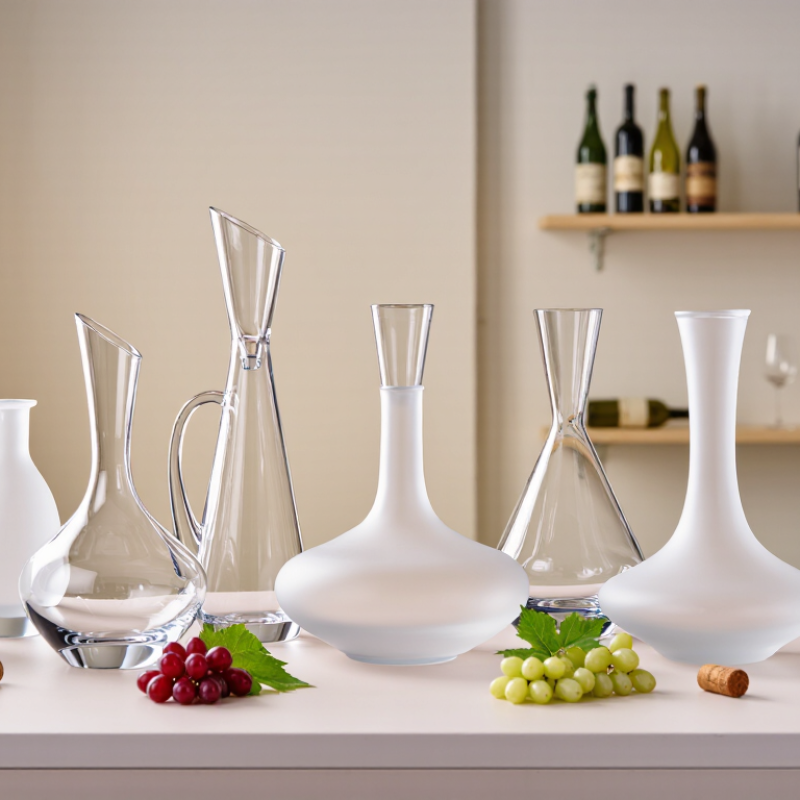
China’s leading wine decanter manufacturers produce several practical designs for different serving needs. Wide-base decanters expose more wine to air and suit young, tannic reds. Narrow-neck models reduce aroma loss during short service. Some modern designs use built-in aeration channels, while simple carafes remain easier to clean.
Material choice affects clarity, weight, and durability. Soda-lime glass is affordable and suitable for everyday use. Borosilicate glass handles temperature changes better and feels lighter in the hand. Lead-free crystal offers sharper brilliance and a refined rim, but it can require more careful polishing. Stainless steel may appear in travel or professional settings, although it does not provide the same visual experience.
Reliable factories usually combine machine forming with hand finishing. Inspectors check rim smoothness, wall thickness, bubbles, scratches, and base stability. Food-contact glass should meet relevant Chinese standards, such as GB 4806.5, with migration and safety tests supported by traceable records. Serious suppliers also perform thermal-shock tests and packaging drops before shipment.
Details matter. A decanter that rocks slightly can spill expensive wine. A narrow opening can make washing frustrating. In my experience, clear specifications are more useful than attractive catalog photos. Yet factory inspection is not perfect; occasional pinholes or uneven edges can still appear. Buyers should request samples, test cleaning access, and verify production records before ranking manufacturers.
Comparing Product Quality, Customization, Pricing, and Production Capacity
What Are the Top 10 Wine Decanter Manufacturers in China?
A credible top-ten comparison should begin with verified factory evidence, not attractive catalog photos. The OIV’s 2024 State of the World Vine and Wine Sector report recorded about 214 million hectolitres of global wine consumption in 2023. This supports steady demand for functional, gift-ready decanters. For quality, compare glass clarity, wall thickness, rim polishing, thermal-shock resistance, and lead-free material declarations. ISO 9001 systems help, but batch-level inspection matters more. I have seen small rim defects escape broad quality claims.
Customization separates capable suppliers from trading companies. Ask whether the factory controls mold design, color development, logo application, and packaging assembly. A serious supplier should provide pilot samples before mass production. The Smithers report, The Future of Glass Packaging to 2028, highlights lightweighting and sustainability as important packaging trends. Therefore, compare gram weight, recycled content, carton protection, and breakage rates. Custom molds may require several weeks and a recoverable tooling charge.
Pricing needs a complete cost sheet. Include glass, decoration, packaging, inspection, tooling, and shipping preparation. The lowest unit price is rarely the lowest landed cost. Production capacity also requires proof: monthly furnace output, forming lines, staffing, lead times, and recent order records. Industry surveys commonly distinguish nominal capacity from usable capacity. That difference is often overlooked. A practical review should score the ten manufacturers across quality consistency, customization depth, transparent pricing, and scalable production, then verify claims through samples and independent testing.
What Are the Top 10 Wine Decanter Manufacturers in China? - Comparing Product Quality, Customization, Pricing, and Production Capacity
| Rank | Anonymous Supplier Profile | Typical Product Materials | Common Capacity Range | Product Quality | Customization Capability | Typical MOQ | Indicative FOB Price Range | Typical Lead Time | Estimated Monthly Capacity | Best Suited For |
| 1 | Supplier Profile 01 | Lead-free crystal and high-clarity soda-lime glass | 750–1,800 ml | ★★★★★ Premium | Advanced: molds, logo etching, gift boxes, color options | 500–1,000 units | US$5.80–14.50/unit | 35–55 days | 80,000–150,000 units | Premium retail, hospitality, and gift collections |
| 2 | Supplier Profile 02 | Borosilicate glass and lead-free crystal | 500–1,500 ml | ★★★★★ Premium | Advanced: custom shapes, logos, packaging, and color coating | 300–800 units | US$4.90–12.80/unit | 30–50 days | 60,000–120,000 units | Private-label brands and online retail |
| 3 | Supplier Profile 03 | Hand-blown borosilicate glass | 700–2,000 ml | ★★★★☆ High | Strong: handmade forms, engraving, handles, and gift packaging | 200–500 units | US$6.50–16.00/unit | 40–60 days | 35,000–75,000 units | Artisan collections and boutique wine accessories |
| 4 | Supplier Profile 04 | Lead-free crystal glass | 1,000–2,000 ml | ★★★★☆ High | Moderate to strong: standard mold adaptation, logos, and cartons | 1,000–2,000 units | US$4.20–10.50/unit | 30–45 days | 100,000–220,000 units | Wholesale distribution and restaurant supply |
| 5 | Supplier Profile 05 | Heat-resistant borosilicate glass | 600–1,500 ml | ★★★★☆ High | Strong: custom molds, silicone accessories, logos, and inserts | 500–1,000 units | US$3.80–9.80/unit | 35–50 days | 70,000–140,000 units | Functional everyday use and modern tableware lines |
| 6 | Supplier Profile 06 | Soda-lime glass with lead-free decorative coating | 750–1,800 ml | ★★★★☆ High | Moderate: surface printing, etching, labels, and standard packaging | 1,000–3,000 units | US$2.80–7.50/unit | 25–45 days | 150,000–300,000 units | High-volume promotional and wholesale programs |
| 7 | Supplier Profile 07 | Hand-blown soda-lime glass and crystal glass | 500–1,200 ml | ★★★☆☆ Standard to High | Strong: irregular shapes, handmade details, and small-batch finishes | 100–300 units | US$5.20–13.50/unit | 45–70 days | 20,000–50,000 units | Design-led shops and small specialty orders |
| 8 | Supplier Profile 08 | Lead-free crystal and machine-pressed glass | 750–1,500 ml | ★★★☆☆ Standard to High | Moderate: standard molds, laser engraving, and printed packaging | 800–1,500 units | US$3.20–8.20/unit | 30–50 days | 90,000–180,000 units | Mid-market retail and branded corporate gifts |
| 9 | Supplier Profile 09 | Recycled-content soda-lime glass and standard glass | 500–1,500 ml | ★★★☆☆ Standard | Basic to moderate: logo printing, labels, and stock packaging | 1,500–5,000 units | US$2.20–6.00/unit | 25–40 days | 180,000–350,000 units | Cost-sensitive promotions and large retail orders |
| 10 | Supplier Profile 10 | Standard soda-lime glass | 750–1,800 ml | ★★★☆☆ Standard | Basic: existing molds, decals, labels, and carton customization | 2,000–5,000 units | US$1.80–5.20/unit | 20–35 days | 200,000–400,000 units | Entry-level products and high-volume distribution |
Pricing, minimum order quantities, lead times, and production capacity are indicative China-market ranges for comparable wine decanter suppliers. Actual quotations vary according to glass material, mold development, finishing process, packaging requirements, order volume, testing standards, and shipping terms.
How to Choose a Reliable Chinese Wine Decanter Manufacturer
When comparing the top 10 wine decanter manufacturers in China, avoid judging factories by catalogs alone. A reliable supplier should explain its glass composition, forming process, inspection standards, and production capacity. Ask for recent test reports covering lead-free materials, food-contact safety, and durability. These documents should match the actual product, not a generic file.
Request physical samples before discussing large orders. Check the rim for smooth finishing, the base for stability, and the bowl for clear, bubble-free glass. Pour water into each sample and observe balance, drip control, and pouring comfort. Samples reveal more. Compare sample quality with mass-production promises. Some suppliers present excellent prototypes but fail to maintain the same finish during volume production.
A factory audit can reveal useful details: furnace condition, mold maintenance, worker training, packaging tests, and defect records. Confirm whether quality checks happen during production, not only before shipment. Clarify mold ownership, minimum order quantity, lead time, replacement policy, and export experience in writing. Responsive communication matters when specifications change. It is also wise to contact several existing business references, when available. A manufacturer with transparent limitations may be safer than one promising everything. I would still keep a backup supplier, because delays, breakage, or uneven batches can occur even after careful evaluation.