
How to Choose the Best PCR Thermal Cycler?

Choosing the right Pcr Thermal Cycler is a practical laboratory decision, not a simple comparison of prices and cycle times. In daily use, a small temperature error can change amplification efficiency, especially across a 96-well plate. The consequences may appear as weak bands, inconsistent Cq values, or repeated experiments. That costs more than expected.

Industry research supports this growing need for dependable amplification systems. MarketsandMarkets’ Polymerase Chain Reaction Market report identifies molecular diagnostics, research laboratories, and clinical applications as major growth areas. Grand View Research also describes expanding demand for automated and high-throughput PCR workflows. These reports indicate market momentum, but they do not make every instrument suitable for every laboratory. A busy diagnostic facility needs different capabilities from a small academic research group.

Specifications need context. A fast ramp rate may shorten a run, yet poor temperature uniformity can reduce result consistency. A gradient function helps optimize primers, while a reliable heated lid protects reaction volume. Calibration records, service availability, software usability, and warranty terms also deserve close attention. Standards and guidance, including the MIQE recommendations published in Clinical Chemistry, emphasize careful validation and transparent reporting of quantitative PCR results. Still, no machine is perfect. Real-world performance can change with plastics, reagents, maintenance, and operator habits. A thoughtful selection process therefore examines published data, verifies performance with representative assays, and leaves room for honest uncertainty. That is how this guide approaches the question: How to Choose the Best PCR Thermal Cycler?
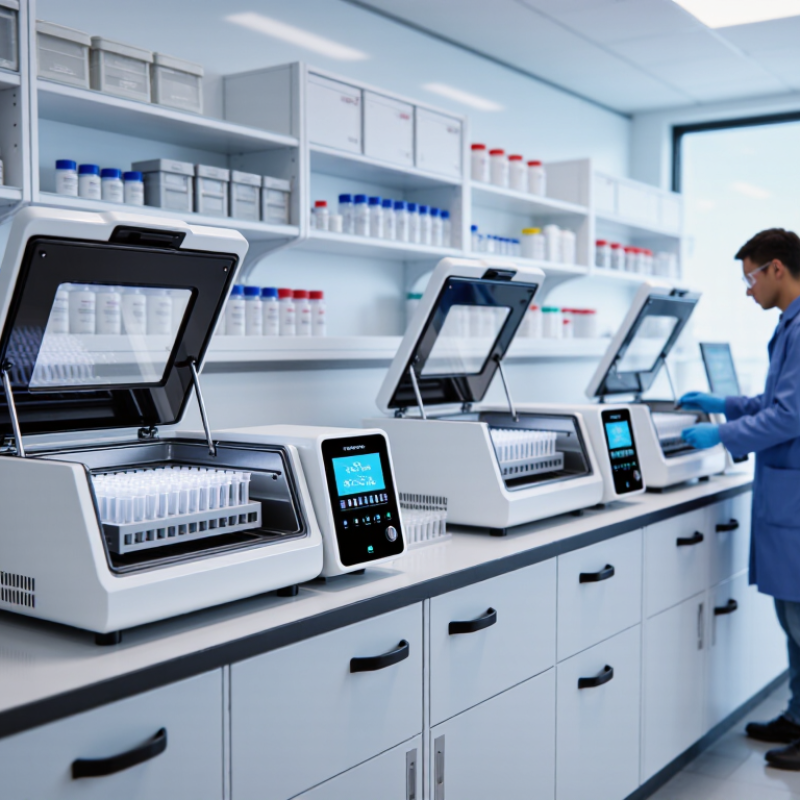
How to Choose the Best PCR Thermal Cycler?

What a PCR Thermal Cycler Does and Why It Matters

How to Choose the Best PCR Thermal Cycler?

A PCR thermal cycler repeatedly changes temperature to copy targeted DNA. It drives denaturation, primer annealing, and extension. Each step depends on stable heating and cooling. Poor uniformity can create uneven amplification across a plate. That matters when samples are limited or results guide further testing.

The instrument’s thermal block is the practical center of the decision. Check temperature accuracy, well-to-well uniformity, ramp speed, and calibration records. A fast ramp is useful, but speed alone can mislead. Reliable temperature control usually matters more than impressive specifications. The MIQE guidelines stress clear reporting of cycling conditions, controls, and assay performance. Those details make results easier to reproduce (Bustin et al., Clinical Chemistry, 2009).

Independent market data also shows why this equipment deserves careful selection. MarketsandMarkets estimated the global PCR market at about USD 10.1 billion in 2024, with continued growth projected through 2029. More laboratories are adopting PCR, but growth does not remove technical mistakes. I would test a cycler with a known assay before routine use. A simple gradient experiment can expose edge-well differences. That extra check may feel slow. It is often cheaper than repeating an entire run. Software usability, service response, and documented calibration should also influence the purchase. A perfectly specified instrument can still disappoint when maintenance records are unclear.

How to Choose the Best PCR Thermal Cycler?

What a PCR Thermal Cycler Does and Why It Matters

A PCR thermal cycler repeatedly changes temperature to separate DNA strands, allow primers to bind, and extend new DNA strands. A typical three-step PCR cycle uses approximately 95°C for denaturation, 55°C for annealing, and 72°C for extension.

When choosing a cycler, prioritize temperature accuracy, well-to-well uniformity, controlled heating and cooling rates, reliable heated-lid performance, and compatibility with the required tube or plate format. These factors help produce consistent amplification across samples.

Key Specifications for Comparing Thermal Cyclers

Choosing the best PCR thermal cycler requires more than comparing prices. Start with temperature uniformity across the block. A small temperature difference can produce uneven amplification, especially in assays with narrow annealing ranges. Check the stated accuracy, uniformity, ramp rate, and temperature range. These figures directly affect reproducibility.

Sample capacity matters too. A 96-well block may suit routine testing, while smaller formats can reduce reagent waste. Confirm the compatible tube, strip, or plate types before purchase. Gradient control is valuable when optimizing primers. It can reveal a usable annealing temperature in one run. Still, a gradient feature cannot repair poorly designed primers.

Software should make protocols easy to edit, store, and audit. Look for clear cycle controls, user permissions, and exportable run records. I once reviewed a system with impressive speed but confusing menus. Fast runs were not helpful when operators repeatedly entered settings incorrectly. Consider heated-lid performance, condensation control, calibration intervals, and local technical support. These details often matter more after installation.

Reliable evaluation includes a practical test. Run the same assay across several wells and compare the results. Ask whether the instrument maintains performance after repeated use. A low purchase price can hide calibration costs, limited service access, or expensive replacement parts. Review independent validation data when available, but question vague claims. The best choice depends on your assay, workload, laboratory skills, and tolerance for troubleshooting.

How to Match a Cycler to Your PCR Applications

How to Choose the Best PCR Thermal Cycler?

Choosing a thermal cycler starts with the assay, not the equipment catalog. For routine endpoint PCR, a reliable block, stable temperatures, and a clear heated lid may be enough. If your work includes qPCR, choose a system with suitable optical channels, consistent excitation, and software that records raw fluorescence data. Multiplex assays need careful spectral separation. Otherwise, weak signals can become confusing results.

Match the block format to your daily workload. A 96-well block suits many standard workflows, while smaller formats can reduce reagent waste. Gradient control helps when primer annealing temperatures are uncertain. High-resolution melt analysis demands excellent temperature uniformity and precise data capture. Fast ramping can shorten runs, but speed is not always better. Some assays need gentle transitions.

In practical lab use, I would check calibration records, service access, and export options before comparing headline specifications. Test several wells across the block with a known control. Small edge effects may appear only after repeated runs. I once focused too heavily on cycling speed and underestimated software limitations. That choice created extra manual work. A cycler should fit your samples, validation plan, staff skills, and future assays. Leave room for learning.

Workflow, Usability, and Laboratory Compatibility

How to Choose the Best PCR Thermal Cycler?

Workflow should guide the purchase, not the product brochure. A busy laboratory needs quick plate loading, readable status signals, and software that prevents skipped steps. Check whether the instrument fits your existing extraction, pipetting, and data-review routines. A small screen can become frustrating during a twelve-hour shift. It happens. WHO reports that laboratory results influence about 70% of healthcare decisions, making avoidable workflow errors costly (WHO, Strengthening Diagnostics Capacity, 2023). Choose a system with clear run recovery, user permissions, and traceable result files. These details matter when several technicians share one bench.

Usability also depends on laboratory compatibility. Confirm block format, reaction volume range, temperature uniformity, calibration support, and local service access. ISO 15189:2022 emphasizes equipment monitoring, calibration, and records that support result reliability. Before routine use, test the cycler with your actual plastics, reagents, and environmental conditions. CLSI EP05-A3 describes a precision study using two runs per day, two replicates per run, across 20 days. That design can expose edge-of-range variation, although it may be impractical for smaller laboratories. Do not treat the manufacturer’s specification as your own evidence. Record loading time, failed runs, temperature alerts, and recovery steps for several weeks. A quieter workflow may be more valuable than a faster headline cycle.

How to Choose the Best PCR Thermal Cycler? - Workflow, Usability, and Laboratory Compatibility

Selection Dimension Recommended Specification or Benchmark Why It Matters in the Workflow Compatibility Check
Primary application Endpoint PCR, cloning, genotyping, sequencing preparation, or mutagenesis The application determines whether basic cycling, gradient optimization, or advanced method control is required. Confirm that the instrument supports the required cycling steps, temperature limits, and hold times.
Sample throughput Select a block format that matches daily workload: 16–32 wells for low volume, 48–96 wells for routine work, or 384 wells for high-throughput workflows. A correctly sized block reduces unused capacity, unnecessary run time, and reagent waste. Check whether the laboratory already uses 0.2 mL tubes, 8-tube strips, or 96-/384-well plates.
Block compatibility Use the same consumable format across the workflow whenever possible; avoid adapters unless they are validated for the intended method. Consistent vessels simplify setup and reduce handling errors, evaporation, and cross-contamination risk. Verify fit, seal quality, optical requirements if applicable, and the availability of compatible consumables.
Temperature range A practical range is approximately 4–100 °C, with a separate heated-lid setting commonly reaching about 100–110 °C. This covers common denaturation, annealing, extension, hold, and post-PCR cooling steps. Check the validated operating range rather than relying only on the maximum displayed temperature.
Temperature uniformity Prefer specifications around ±0.5 °C or better across the block after thermal stabilization. Uniform wells improve reproducibility between samples and reduce position-related variation. Ask for the test method, stabilization time, and whether performance is verified across the entire block.
Temperature accuracy Look for stated accuracy near ±0.5 °C or better within the validated operating range. Accurate temperature control is important when optimizing primer annealing or reproducing established protocols. Confirm whether calibration can be documented with traceable temperature verification.
Heating and cooling rate A nominal maximum rate of approximately 3–6 °C per second is suitable for many routine PCR workflows. Faster transitions can shorten runs, but actual protocol performance also depends on sample volume and ramp settings. Compare effective ramp rate at the intended sample volume, not only the headline maximum rate.
Gradient capability Choose a temperature gradient function when primer pairs, templates, or master mixes require optimization. Gradient testing can identify a suitable annealing temperature without running many separate experiments. Check the gradient span, number of independently controlled zones, and how the software displays actual well temperatures.
Heated-lid control An adjustable heated lid with pressure or temperature control is preferred for low-volume reactions. The lid helps limit condensation and changes in reaction concentration during high-temperature steps. Verify compatibility with tubes, strips, plates, seals, and the selected reaction volume.
Protocol programming The system should support repeated cycles, temperature increments or decrements, pauses, holds, and optional time or temperature adjustments. Flexible programming supports optimization, touchdown PCR, long-range PCR, and multistep workflows. Test whether protocols can be edited, copied, locked, exported, and recovered after interruption.
User interface Use a clear touchscreen or computer interface with readable protocol steps, run status, remaining time, and error messages. Simple operation reduces training time and minimizes setup mistakes during repetitive work. Evaluate usability with gloves, user permissions, barcode or sample naming needs, and local network policies.
Run documentation Prefer automatic recording of protocol name, operator, date, run status, temperature data, and deviation history. Electronic records support traceability, troubleshooting, quality control, and repeatability. Check export formats, audit-trail functions, data retention, and integration with laboratory systems.
Calibration and verification Choose a unit with a documented calibration procedure and a recommended periodic verification schedule. Regular verification helps identify thermal drift before it affects assay performance. Confirm service availability, certificate requirements, calibration interval, and instrument self-diagnostics.
Contamination control Use sealed vessels, dedicated clean and post-amplification areas, and surfaces that tolerate routine laboratory disinfection. PCR amplicons can contaminate future reactions and cause false-positive results. Review cleaning instructions, chemical compatibility, removable components, and the laboratory’s contamination-control SOP.
Power and environmental requirements Confirm local voltage, frequency, ambient temperature, humidity limits, ventilation, and bench-space requirements. Environmental mismatch can reduce reliability, interrupt runs, or create safety and maintenance issues. Check electrical protection, uninterruptible-power needs, clearance around vents, and allowable operating conditions.
Best overall selection rule Choose the simplest instrument that meets the required block size, thermal performance, documentation, and validation needs. Avoid paying for unused capacity while preserving enough flexibility for expected changes in workload and assay design. Run a practical evaluation using representative samples, current consumables, typical protocols, and the laboratory’s quality requirements.
Important: Published specifications may be measured under different conditions. Compare instruments using the same sample volume, consumable format, protocol, calibration method, and acceptance criteria.

Reliability, Support, and Total Ownership Cost

A PCR thermal cycler is only valuable when it delivers repeatable results under daily pressure. Check temperature uniformity, ramp-rate consistency, calibration records, and error logs. Ask for independent validation data, not only brochure specifications. The details matter.

Reliability also includes service. The U.S. Bureau of Labor Statistics reported that wages and benefits represented 70.1% of private-industry employer costs in December 2024. A failed instrument can therefore waste more than its repair invoice. Estimate the cost of delayed runs, repeated samples, overtime, and lost staff time. Require clear response times, local technical support, preventive-maintenance options, and available replacement parts. A low purchase price may age badly.

Use a five-year ownership model. Include acquisition, installation, calibration, software updates, energy use, service contracts, consumables, and disposal. The U.S. Department of Energy’s life-cycle-cost guidance also treats maintenance and operating expenses as core purchasing factors. Compare these costs across realistic workloads, such as 200, 1,000, or 3,000 runs annually. Keep evidence.

In practice, support quality is difficult to judge before failure. Request anonymized uptime figures, escalation procedures, and a sample service report. Speak with current laboratory users, if possible. One weakness remains: public reliability data are often inconsistent across suppliers. That makes transparent testing and documented assumptions essential.